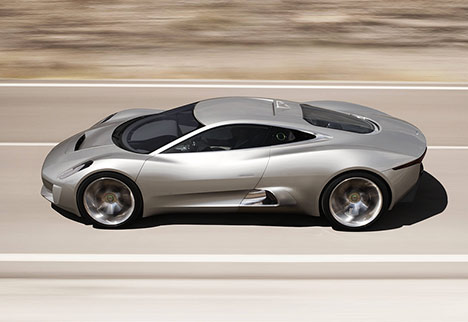
The Jaguar XJ220 is a mid-engined supercar produced by Jaguar in collaboration with Tom Walkinshaw Racing as Jaguar Sport between 1992 and 1994. It held the record for the highest top speed of a production car (350 km/h, 217 mph) (although it was modified from standard to achieve this), until the arrival of the McLaren F1 in 1994. The XJ220 is unrelated to other XJ models, despite sharing the "XJ" prefix.In the early days of the company, certain Jaguar employees had created an informal group they called "The Saturday Club" (so-named because they would meet after-hours and on weekends to work on unofficial pet-projects). In the 1980s, Jaguar's chief engineer Jim Randle, as part of that group, began work on what he saw as competition for cars like the Ferrari F40 and Porsche 959. He envisioned what was essentially an updated XJ13 - a lightweight two-seater with a powerful mid-mounted V12 engine. Randle expanded on the idea by settling on all wheel drive for increased traction and better handling and an integral safety-cage so the car could be safely raced at extremely high speeds. From the outset, the intention was to create a vehicle capable of exceeding 320 km/h (200 mph).Jaguar executives who saw the concept were sufficiently impressed to formally commit company resources to producing a car for the 1988 British Motor Show. Tom Walkinshaw Racing was engaged to produce a 6.2-litre version of Jaguar's V12 engine with four valves per cylinder, quad camshafts, and a target output of 500 hp (370 kW; 510 PS). The all-wheel drive system was produced by FF Developments, who had experience with such systems going back to the 1960s and the Jensen FF. The styling of the car was done by Keith Helfet and included scissor-style doors similar to those in use by Lamborghini in several of their cars. The name "XJ220" was assigned as a reference to the targeted top speed of 220 mph (350 km/h). The prototype car was significantly heavier at 1,560 kg (3,439 lb) than other Jaguar racers like the XJR-9. But as it was intended to be, first and foremost, a roadcar, it would be more appropriate to compare it with something like the XJS; in spite of being 30-inch (762 mm) longer and 10-inch (254 mm) wider and even with the added weight of the all-wheel drive system, the XJ220 was still 170 kg (375 lb) lighter than the XJS. The car was officially announced in 1989 with a price of £361,000 ($580,000 USD) and prospective buyers were expected to put up a deposit of £50,000 ($80,000 USD) to be put on the waiting list for delivery. Because Jaguar promised to limit initial production to 220 units and that total production would not exceed 350, many of those who put deposits on the cars were speculators who intended to sell the car at an immediate profit.

The production version of the car was first shown to the public in October 1991 after undergoing significant changes. The most obvious of which was a completely different drivetrain and the elimination of the scissor doors. TWR was charged with producing the car and had several goals/rules: the car would be rear wheel drive instead of all wheel drive; would have a turbocharged V6 engine instead of the big V12; and performance goals of over 200 mph (320 km/h), 0 to 60 mph (97 km/h) in 3.8 seconds, and the lightest weight possible. The 6.2-litre V12 had been judged too difficult to get past increasingly strict emission regulations, and there were also reportedly some design problems caused by the size of the power plant. It was replaced with a Tom Walkinshaw-developed 3.5-litre V6 based on the engine used in the Austin Metro 6R4 rally car and fitted with twin Garrett T3 turbochargers, generating 542 bhp (404 kW; 550 PS) of maximum power at 7000 rpm and 476 lb·ft (645 N·m) of torque at 4500 rpm. This engine was the first V6 in Jaguar's history, and was the first to use forced induction. In spite of the smaller displacement and half the number of cylinders, the engine produced more power than the V12 would have. However, potential customers judged the exhaust note to be harsh and the lag from the turbos to be an annoyance. Also missing from the production version of the car was the Ferguson all wheel drive – the production car had only rear driven wheels, through a conventional transaxle – and the ABS. With the promise of four-wheel drive and a 500bhp Jaguar V12 this sounded like a dream come true for enthusiasts and speculators alike. Unfortunately, when production finally began in the early 90s, the boom had gone and Group B (for which the XJ220 was originally conceived) had disappeared. Not only this but Jaguar had made the unpopular decision to drop the 4WD and V12 drivetrain for RWD and turbocharged V6. This led to disgruntled customers, many of whom launched court cases against Jaguar, only to lose, and ultimately unsold 220s.The car entered production in 1992 in a purpose-built factory at Bloxham near Banbury, and the first cars were delivered to customers in July. Original customers included Elton John and the Sultan of Brunei.
Jaguar XJ 220

Many of the initial customers were dissatisfied not only with the modifications to the original specification but the significant increase in delivery price from the original £361,000 to £403,000 ($650,000 USD). Another blow to potential sales was a global recession which took hold between the car's original announcement and its eventual release. This caused many original speculators to not want to buy the car, either because they were no longer able, or because they did not think they could sell it on. Further complicating the issue was Tom Walkinshaw's offer of the faster (by acceleration, not top speed), more expensive and more exclusive XJR-15 which was based on the Le Mans champion XJR-9. Some customers reportedly either sued Jaguar or threatened to sue; in any case, Jaguar gave the customers the option to buy themselves out of the delivery contract. As a result, many of the owners challenged Jaguar in court where the Judge eventually sided with Jaguar. To reduce costs the use of parts from mass production cars had been extensive; for example the rear view mirrors came from the Citroën CX 2 Series. In spite of the drama surrounding its creation, a total of 281 cars were made and by 1997, few of these remained available for sale new at £150,000. Nowadays, it remains a sought-after collectible sports car, fetching £100,000+.The XJ220 is not only the fastest but the widest car Jaguar has ever built at nearly 7 feet in width. A racing version called the XJ220C was also made. The XJ220C, driven by Win Percy won its first race, a round of the BRDC National Sports GT Challenge at Silverstone. Three works XJ220C's were entered in the 1993 Le Mans 24 Hour race, in the newly created Grand Touring Class. Two of the cars retired but one XJ220, driven by John Nielsen, David Brabham and David Coulthard took the checkered flag to take a class win. This, however, was revoked two weeks later when the XJ220C was disqualified for not running catalytic converters on the cars when the road-going XJ220s did. An XJ220 would also be used in the Italian GT Championship in the early 1990s, although this car had no factory support. During the mid-nineties, the Sultan of Brunei and his brother Prince Jefri secretly bought hundreds of sports cars and had them custom appointed by various companies. One of these is a custom Jaguar XJ220 that has been heavily modified by Pininfarina. Modifications included fixed headlights, replacing the pop-up versions originally installed, and a redesigned double-vane rear wing.In 1992 at the Nardò Ring, Martin Brundle drove an XJ220 to 212.3 mph (341.7 km/h). The car's catalytic converters sap the engine of an estimated 60 bhp (45 kW), the catalysts were later disconnected and the rev limiter was increased from 7200 rpm to 7900 rpm in a quest to enable the XJ220 reach a higher top speed. On a later run with the modifications, Brundle took the XJ220 to 217.1 mph (349.4 km/h) (the equivalent to approximately 223 mph (359 km/h) on a straight road).

 Emazing Purple Jaguar XJ220
  Black Jaguar XJ220 Concept
 The prototype car was significantly heavier at 1,560 kg (3,439 lb) than other Jaguar racers like the XJR-9. But as it was intended to be, first and foremost, a roadcar, it would be more appropriate to compare it with something like the XJS; in spite of being 30-inch (762 mm) longer and 10-inch (254 mm) wider and even with the added weight of the all-wheel drive system, the XJ220 was still 170 kg (375 lb) lighter than the XJS.
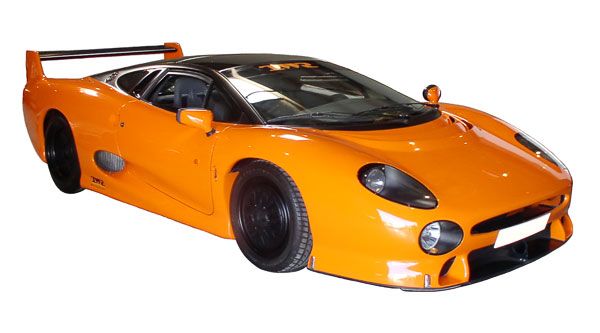 Orange Jaguar XJ220 Looks so Sporty
 Silver Jaguar XJ220 Front View
 The car was officially announced in 1989 with a price of £361,000 ($580,000 USD) and prospective buyers were expected to put up a deposit of £50,000 ($80,000 USD) to be put on the waiting list for delivery. Because Jaguar promised to limit initial production to 220 units and that total production would not exceed 350, many of those who put deposits on the cars were speculators who intended to sell the car at an immediate profit.